


Just outside the city of Utrecht, to the north-west of Vleuten-De Meern, lies the 400-hectare recreation and nature area known as ‘Landgoed Haarzuilens’ (Haarzuilens Estate). The area is best known for the monumental De Haar Castle, which attracts around ten thousand visitors each year. In addition to its rich cultural history, Haarzuilens features a varied landscape of grassland, arable fields, orchards, ditches and woodland. The area is divided into several compartments that remain visually and physically connected, making it a popular walking and cycling area for residents of the surrounding neighbourhoods and villages.
“When I walk through the area today, I am genuinely proud of what we have been able to achieve together, despite all the setbacks,” says Mieke Span, senior adviser for recreation and green space at the municipality of Utrecht. In the 1990s she helped draft the final land development plan for the Haarzuilens estate and has been involved in its implementation since 2000. “Haarzuilens was designated under the Recreatie om de Stad [Recreation around the city, RodS] programme to absorb recreational pressure to the west of Utrecht. Funding came mainly from central government, and the Government Service for Land and Water Management [Dienst Landelijk Gebied] acquired land and carried out the works. However, in 2011 the RodS programme was discontinued due to national budget cuts, and suddenly we had no money left. We could no longer acquire land, develop land already acquired or manage the areas we had already completed. So we sat down again with the area partners to explore what was still possible. We called it calculating and drawing.”
Redesigning the plan
“The entire design for the new Parkbos had to be redone,” recalls Claudia van Holsteijn, project leader at Natuurmonumenten (Society for the Preservation of Nature in the Netherlands). “The land acquired was smaller than originally planned, and there were gaps throughout. Even so, we wanted to create a successful area, albeit with less money. That meant looking at all components in an integrated way. Together we worked out how to incorporate the meadowland into the landscape so that visitors would experience the area as a beautiful coherent whole. We really developed the new design together with the land manager, so that maintenance costs for Natuurmonumenten could be kept low. After all, we suddenly had to manage the area without national support.”
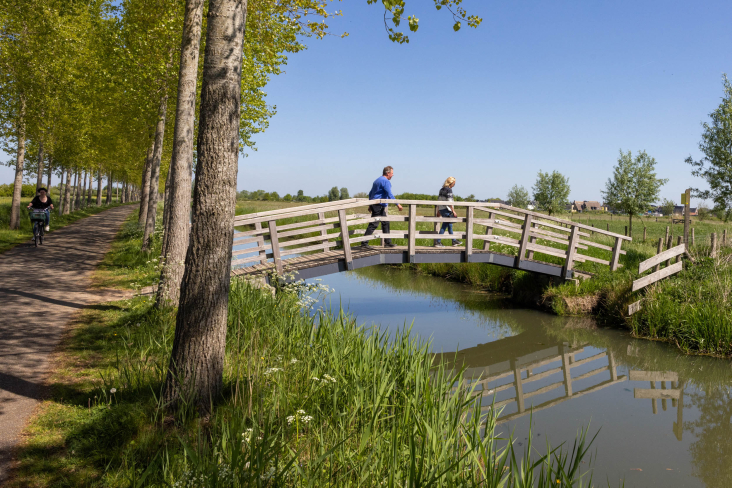
In the end, the partners succeeded in creating a beautifully varied landscape, more modest than originally envisaged but very well used. New cycling and walking paths have been created, and visitors can enjoy the orchards and the hospitality facilities. In addition, a beautiful park Parkbos (park woodland) has been created with the help of thousands of volunteers, and in Wielrevelt you can follow an archaeological walking route. The existing ribbons of housing, which predated the redevelopment, have remained visible as independent elements of cultural history. Although the ‘carrying capacity’ of the area (the number of visitors it can host at one time) is lower than planned, the result is impressive and highly valued by local residents, partners and recreational users.
Financing
The project ultimately succeeded thanks in part to additional funding that could be secured for development and management of the area. The partners – the province of Utrecht, Recreatieschap Midden Nederland (Recreation Board for Central Netherlands) and the municipalities of Utrecht, IJsselstein, Houten and Bunnik – reached an agreement with Natuurmonumenten and Staatsbosbeheer (National Forest Service in the Netherlands) to jointly fund the management of various RodS recreation areas. The Ruimte voor Ruimte (space for space) scheme was also used, allowing limited new development in the vicinity; the resulting ground lease income supported long-term management. Together with the remaining provincial and regional project funds available in 2011, this enabled the construction of the Parkbos.
Challenges for the future
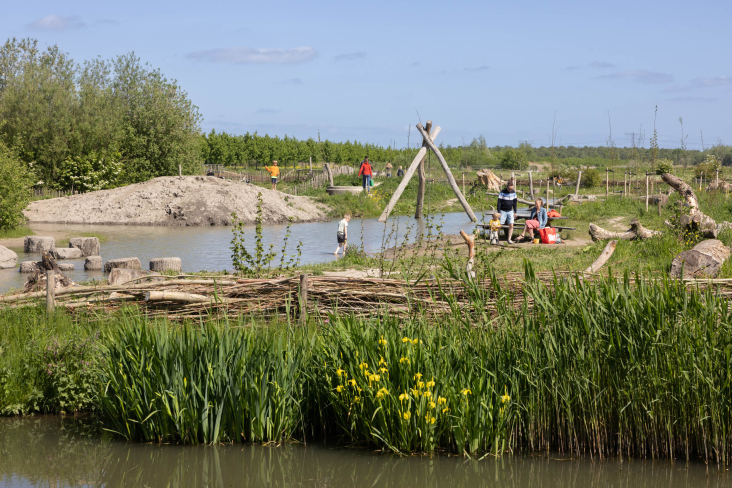
There are now plans to create a new hospitality facility along the Verlengde Parkweg. A new nature play area has also recently been created, which is heavily used by children from Leidsche Rijn. A key challenge for Natuurmonumenten is to safeguard the area for the long term. This is not always easy with increasing housing development nearby and management funding that has only been committed for four years by regional partners. “We are very grateful for the support we receive, yet it would be more reassuring to have a growth model that guarantees funding for a longer period,” Claudia van Holsteijn explains. “This landscape will still be here two hundred years from now, but the politicians who decide on its future will be gone again in four years. That makes long-term planning complicated.”
Claudia and Mieke’s greatest wish is to one day complete the area in full accordance with the original plan. “Funding and land availability are essential, of course, but we have already shown how far we can get with relatively little money and careful planning and design. If the resources become available, we would gladly turn this into an even larger, more varied, more beautiful and more playful nature and recreation landscape.”
Contact
If you would like to know more about the Haarzuilens estate, please contact:
Claudia van Holsteijn
Public Affairs Officer, Natuurmonumenten
c.vanholsteijn@natuurmonumenten.nl
06 1298 7823