


A new nature and recreation area, De Groene Grens, is being developed on the boundary between Veenendaal and Ede. The area consists of a long, linear series of nature sites and forms an ecological green buffer between the two municipalities. This prevents the towns from merging into one another and ensures there is sufficient space for nature, water storage and recreation.
“The De Groene Grens project lies to the east of the Veenendaal-Oost development area, where a total of three thousand dwellings are being built,” explains project manager Marie-Louise van Lankveld of the municipality of Veenendaal. “To create space for this, we agreed with the municipality of Ede to shift our municipal boundary further to the east. In return, new nature has been created on land within the municipality of Ede.”
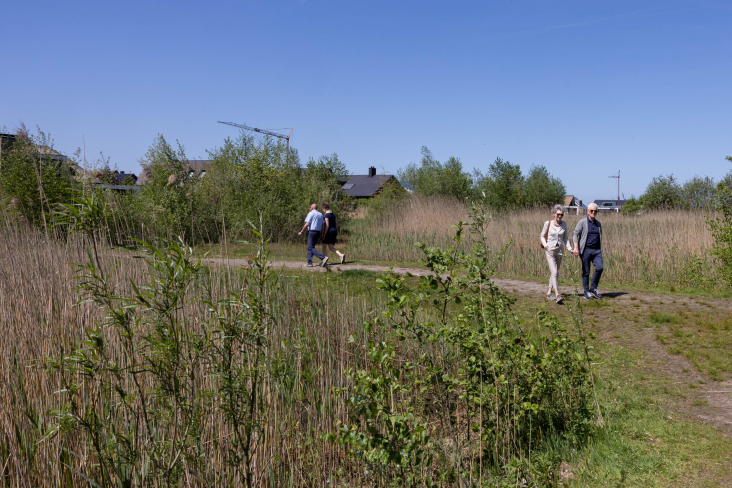
The Groene Grens nature area will cover fifty hectares in total, of which around two thirds have now been completed. Construction of the area is scheduled to be finalised in the second half of 2022. “Most of the area is, or will be, designated for nature,” Marie-Louise explains. “A smaller part is intended for recreation, including as a nearby green space for residents of the adjacent Veenendaal-Oost residential area as well as for other visitors. In addition, three hectares have been reserved for water storage for Veenendaal-Oost.”
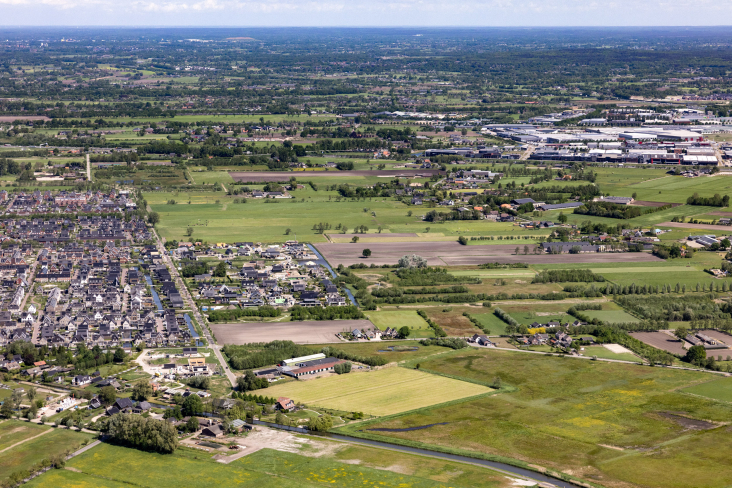
Location of De Groene Grens
De Groene Grens stretches from Allemanskamp and Meeuwenkampje in the north to De Hel, De Blauwe Hel, De Bennekomse Meent and the nature area along the Grift in the south. At the southern end, near the Meentdijk, the area connects directly to the Binnenveldse Hooilanden. As such, it forms a long ecological corridor through the Binnenveld, from the A12 motorway to near the Blauwe Kamer.
Unique natural values
The nature in De Groene Grens consists of a sequence of small landscape elements such as hedgerows, small woodland patches, scrub and ponds. These are surrounded by hay meadows, bluegrass meadows, the (nationally rare) calcareous fens and arable fields with traditional crop varieties. Due to the particular groundwater seepage conditions in the area, many rare plant species grow here, including orchids, marsh gentian, marsh lousewort and grass of Parnassus. Numerous bird species are also present, such as kingfisher, cuckoo, buzzard and spoonbill. Together, these natural values make De Groene Grens a unique landscape.
Funding through sale of individual plots with a unique Green Guarantee
The municipality of Veenendaal has funded most of the land acquisition and development of nature in De Groene Grens from the proceeds of selling sixty individual plots to private buyers for homes in Balkon-Zuid. These are higher-price plots located next to the Veenendaal-Oost development area, within De Groene Grens. A dedicated plot adviser (kavelcoach) was appointed, focusing specifically on the target group able to purchase these plots.
A key selling point for prospective buyers was that the municipality of Veenendaal issued a Green Guarantee (Groen Garantie) for this building project. This guarantee takes the form of an easement on the plots, ensuring that the newly created nature will be preserved for at least fifty years. It was the first time in the Netherlands that a municipality provided such a Green Guarantee.
Additional contributions came from:
- the province of Gelderland, which created fourteen hectares of nature on land designated as part of the Natuurnetwerk Nederland (Nature Network Netherlands).
- the development company Ontwikkelingsmaatschappij Veenendaal-Oost, which funded the water storage facilities in De Groene Grens and created a dog walking area for residents of the Veenendaal-Oost residential area.
- Rijkswaterstaat, which planted woodland in De Groene Grens to compensate for tree felling for the widening of the A12/A50 motorways.
A major financial low point in the project was the housing market crisis around 2012. This was overcome in part thanks to the Nationaal Groenfonds (National Green Fund), which was able to provide the municipality of Veenendaal with low-interest financing.
Land acquisition without compulsory purchase
The municipality of Veenendaal acquired the land in De Groene Grens and Balkon-Zuid on a voluntary basis from the then landowners. Agreements were also made with a project developer that held land in Balkon-Zuid. Several farmers in the area decided to stop farming and made use of the Ruimte voor Ruimte (space for space) scheme.
There was also a dairy farmer in the area who was highly motivated to switch to nature-friendly farming. The municipalities of Veenendaal and Ede worked together to secure the future of this dairy farm by enabling expansion of its land holding. A new footpath from Veenendaal-Oost through De Groene Grens now provides better access to the farm shop selling local products.
Partners
Many partners were involved in creating De Groene Grens, including the municipalities of Veenendaal and Ede, the province of Gelderland, Vallei en Veluwe water authority, Staatsbosbeheer (National Forest Service in the Netherlands), the Mooi Binnenveld Foundation, Rijkswaterstaat, Nationaal Groenfonds (National Green Fund) and Van Ruiswijk dairy farm.
Contact person for further information
Marie-Louise van Lankveld of the municipality of Veenendaal was project manager for this project. “Thanks to the excellent cooperation within a strong project team, this has been a project with only winners,” she concludes. For questions and further information, Marie-Louise can be contacted at marie-louise.van.lankveld@veenendaal.nl.